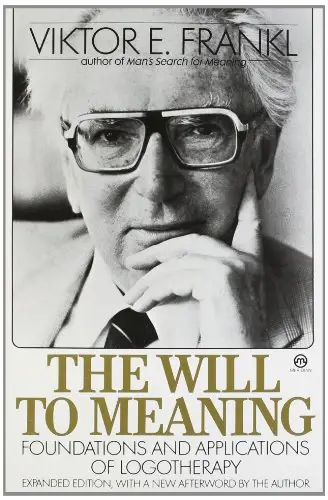
Viktor Frankl's The Will to Meaning: On the Search for a Reason to Become Happy
There is a particular kind of tiredness that is hard to name. Not the tiredness of overwork — though that may also be present — but something quieter and more unsettling. A sense that things are being done, that life is moving forward, but that none of it quite reaches you. You are present, and yet not quite here.
Viktor Frankl knew this experience intimately. And he devoted his life to understanding it.
Who Was Viktor Frankl?
Frankl was a psychiatrist, psychotherapist, and philosopher — and a survivor of four Nazi concentration camps, including Auschwitz and Dachau. His first book, Man's Search for Meaning (...trotzdem Ja zum Leben sagen — "Say Yes to Life in Spite of Everything"), was published in 1946, just months after his liberation. It is not a distant, analytical text. It is written from inside the experience — a phenomenological return to the most extreme conditions of human existence, asking the question that Frankl would never stop asking: what allows a person to keep living?
The answer, for Frankl, was never comfort, or safety, or the removal of suffering. It was meaning.
He often returned to a line from Friedrich Nietzsche: "He who has a why to live can bear almost any how." Following the existential philosophers — and grounding their thought firmly in clinical practice — he concluded that when a person loses felt contact with any sense of value or direction in life, something essential in them begins to collapse. He called this state the existential vacuum: not a dramatic breakdown, but a slow emptying-out. A background sense that nothing quite matters. An absence of an answer to the question: for what?
This was not, for Frankl, a philosophical curiosity. He identified it as the central source of modern psychological suffering. And he devoted his therapeutic approach — logotherapy, from the Greek logos, meaning "meaning" — to helping people find what is personally and uniquely their own.
The Existential Vacuum: When Life Loses Its Direction
The concept of the existential vacuum may be Frankl's most enduring gift to our moment. We live in a world saturated with choice, information, and stimulation — and yet rates of meaninglessness, burnout, and quiet despair continue to rise. Frankl anticipated this with striking clarity.
He understood that external abundance does not fill an inner emptiness. That telling someone to "stay positive" or "be grateful" does not address the actual question their existence is asking. That question, in Existential Analysis (the approach developed by Alfried Längle, one of Frankl's close collaborators), belongs to the Fourth Fundamental Motivation of human existence: For what should I act? What, in this situation, is genuinely calling me?
When a person cannot find a living answer to this question — not a theoretical one, but one that actually moves them, one that earns what Längle calls Zustimmung (inner consent) — they drift. They perform their life rather than living it. They fill their days with activity that produces no real satisfaction. Or they stop, overwhelmed by a blankness they cannot explain.
This is not weakness. This is what happens when the will to meaning — Frankl's Wille zum Sinn — finds no object in the world to move toward.
The Paradox of Happiness — and Why It Matters
The Will to Meaning, first published in 1969 as a collection of lectures and essays, brings these ideas into the texture of everyday life. The book is written in clear, unhurried language — Frankl had a genuine sense of humor and deep warmth for his readers, and both qualities are present throughout.
At the center of the book lives a paradox that many of us have felt but perhaps never named:
The more directly a person pursues happiness, the less likely they are to find it.
Frankl observed that modern culture — and American culture in particular — treats happiness as a destination to be reached by the right combination of effort and attitude. But happiness, in his understanding, is not an end. It is a consequence. It follows from something else: from having found a reason, a genuine engagement, a felt sense of what this life — this particular, irreplaceable life — is for.
He wrote: "Happiness cannot be pursued; it must ensue. One must have a reason to 'be happy.' Once the reason is found, however, one becomes happy automatically... a human being is not one in pursuit of happiness but rather in search of a reason to become happy."
This is not pessimism. It is, in fact, a radical and generous reorientation — an invitation to stop chasing the feeling and start attending to what makes the feeling possible. To stop asking "why am I not happy?" and begin asking: what genuinely matters to me? What is this moment asking of me? Meaning is not an emotion. It is what restores the ground under emotional life.
What This Book Offers Us Today
In a time of sustained uncertainty, disorientation, and a widespread loss of bearings, The Will to Meaning reads less like a historical document than like a quiet, steady companion. It does not offer techniques. It does not promise a cure. It offers something rarer: a way of orienting oneself — toward what is genuinely real, toward what the situation is actually asking, toward the irreplaceable particularity of one's own existence.
Frankl wrote for anyone who has ever felt the gap between being alive and truly living. That is to say, he wrote for most of us.
If you are drawn to existential questions — about purpose, about authenticity, about what suffering might carry, about what makes a life feel worth living — this book is a generous and honest place to begin.